A small thing I would like you to decide

Five trees.
One of them is yours to pick.

I want to grow a bonsai from scratch, and I would rather it was one you chose than one I settled on.

I have been reading about these for weeks and I still cannot choose, which is either research or stalling. So here are the five that made the shortlist. All of them will actually survive a Gurgaon balcony, which ruled out a lot of prettier options.

Turn each one around, and switch to the photographs to see real ones people have actually grown. Everything good and bad about each is written down honestly, including the two that will probably make me suffer.

Then pick. Heart the ones you like, and mark the single one you would start with. That is the one I will buy first.

5 species, shortlistedAll frost-tenderGurgaon runs 4°C to 46°C2 of them flower
growing
02   Weeping Fig

Dwarf Umbrella Tree

Schefflera arboricola

The forgiving one
Excellent for Gurgaon

How it could look. An impression at 25 to 60 cm, not a photograph.
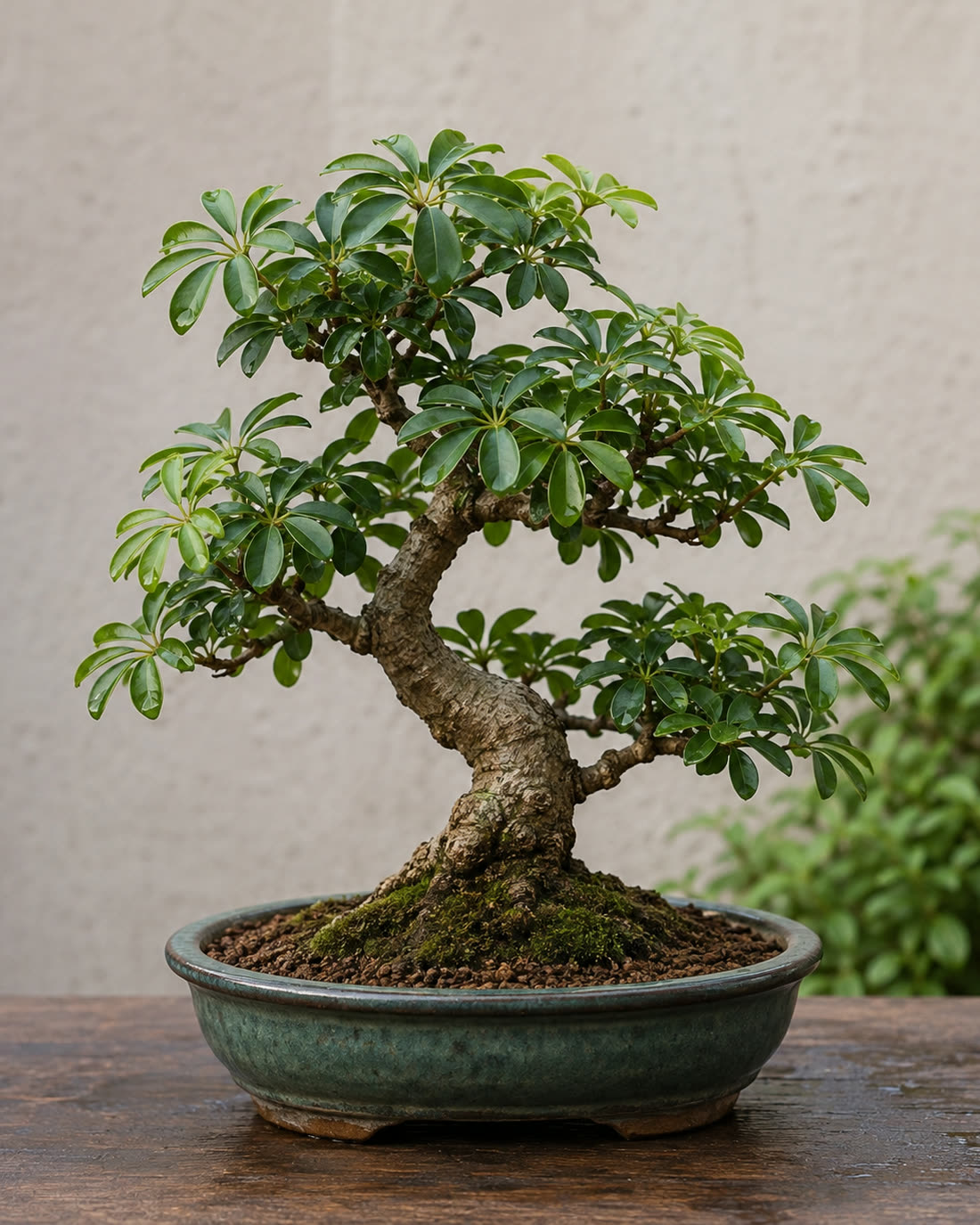
Dwarf Umbrella Tree grown as a bonsai
Family AraliaceaeFrom Taiwan and HainanReady in 6 to 18 months to look convincingStyles Banyan, Root-over-rock, Clump, Informal upright

A glossy, low-light houseplant that turns into a miniature banyan if you let it drop aerial roots.

Schefflera is the tree that refuses to die. It will take a dark corner, a missed fortnight of watering and an air-conditioned room, and simply keep growing. In exchange it never quite behaves like a classic bonsai, because its stems stay half-soft, so it does not thicken and scar the way a real tree does. Growers stopped fighting that decades ago and started styling it as a tropical banyan instead: many trunks, a flat canopy, and curtains of aerial root running down onto a rock.

DifficultyVery easy
Forgives neglectBulletproof
How fast it gets thereQuick
The show it puts onUnderstated
What is good about it
  • Almost impossible to kill, and the most forgiving tree on this list by a distance
  • Happy in genuinely low light, which no other tree here will accept
  • Grows fat aerial roots in humidity, and they fuse into dramatic banyan pillars
  • Cheap and available in every nursery in NCR
  • Recovers from a hard chop quickly and back-buds freely
  • Handles indoor air-conditioning better than any of the others
What it will cost you
  • Never becomes a proper bonsai. Stems stay semi-woody, so cuts do not callus over cleanly
  • Wire bites into the soft bark fast, so styling is mostly clip-and-grow
  • Leaves reduce only so far, and up close the scale never fully convinces
  • Little taper in the trunk unless you build it from a fused clump
  • Goes leggy and stretched if the light stays too low for too long

In Gurgaon

The safest possible starting tree for a Gurgaon flat.

Summer, April to June
Bright shade on a balcony is perfect. Full May and June sun will scorch the leaves, and the dry loo wind crisps the edges, so keep it behind shade cloth or a metre back from the railing.
Monsoon, July to September
Its best season. Warmth plus humidity is exactly when it throws aerial roots, so this is when you mist the trunk and start the banyan work.
Winter, December to February
Bring it indoors below about 10°C. It is the only one here that will genuinely be happy in a room all winter, away from the December fog and the cold draught off a window.
Water here
Not fussy about Gurgaon's hard water. Let the top 2 cm dry, then water thoroughly until it runs out of the drainage holes.
Dust and air
Wipe the leaves every couple of weeks. The October to January dust film dulls the gloss and blocks light, and glossy leaves are the whole point of this tree.
Where it lives
East-facing balcony or a bright window. Indoors year-round is genuinely viable.
The actual care routine, and what it looks like
Leaf
Palmate, 7 to 9 glossy leaflets on a single stalk, like a small green umbrella
In the wild
In its native Taiwan it grows as a scrambling understorey tree, often starting life on another tree and sending roots down to the ground. Those umbrella-spoke leaves are the giveaway: seven to nine leaflets radiating from a single point.
As a bonsai
Grown as a banyan: a fat buttressed base, aerial roots fused into pillars, and a flat green canopy floating above. It reads as a tree from a distance and as a houseplant up close, which is the honest trade.
Light
Bright indirect light is ideal. Tolerates low light. Avoid harsh direct afternoon sun.
Water
Water when the top 2 cm is dry. It would rather be a little dry than a little wet.
Soil
Free-draining. In NCR: crushed red brick grit, coarse river sand, and a third leaf mould or cocopeat.
Feeding
Balanced liquid feed fortnightly from March to October. Stop in winter.
Pruning
Clip-and-grow. Cut back to two leaves once a shoot runs to five or six. It will bud back on old wood.
Repotting
Every two years in February or March, just before the spring flush. Roots take disturbance well.
Pests
Scale and mealybug in the leaf axils, spider mite if the indoor air is very dry. Both are easy to catch early.
Where to buy one
Everywhere. Any nursery on Sohna Road or in the Delhi nursery belt will have variegated and plain forms for a few hundred rupees.
Mildly irritantSap and leaves contain calcium oxalate, which irritates mouth and skin. Keep it off the floor if there are cats or small children about.
Pick as many as you like.

Weeping Fig

Ficus benjamina

The local giant
Excellent for Gurgaon

How it could look. An impression at 30 to 70 cm, not a photograph.
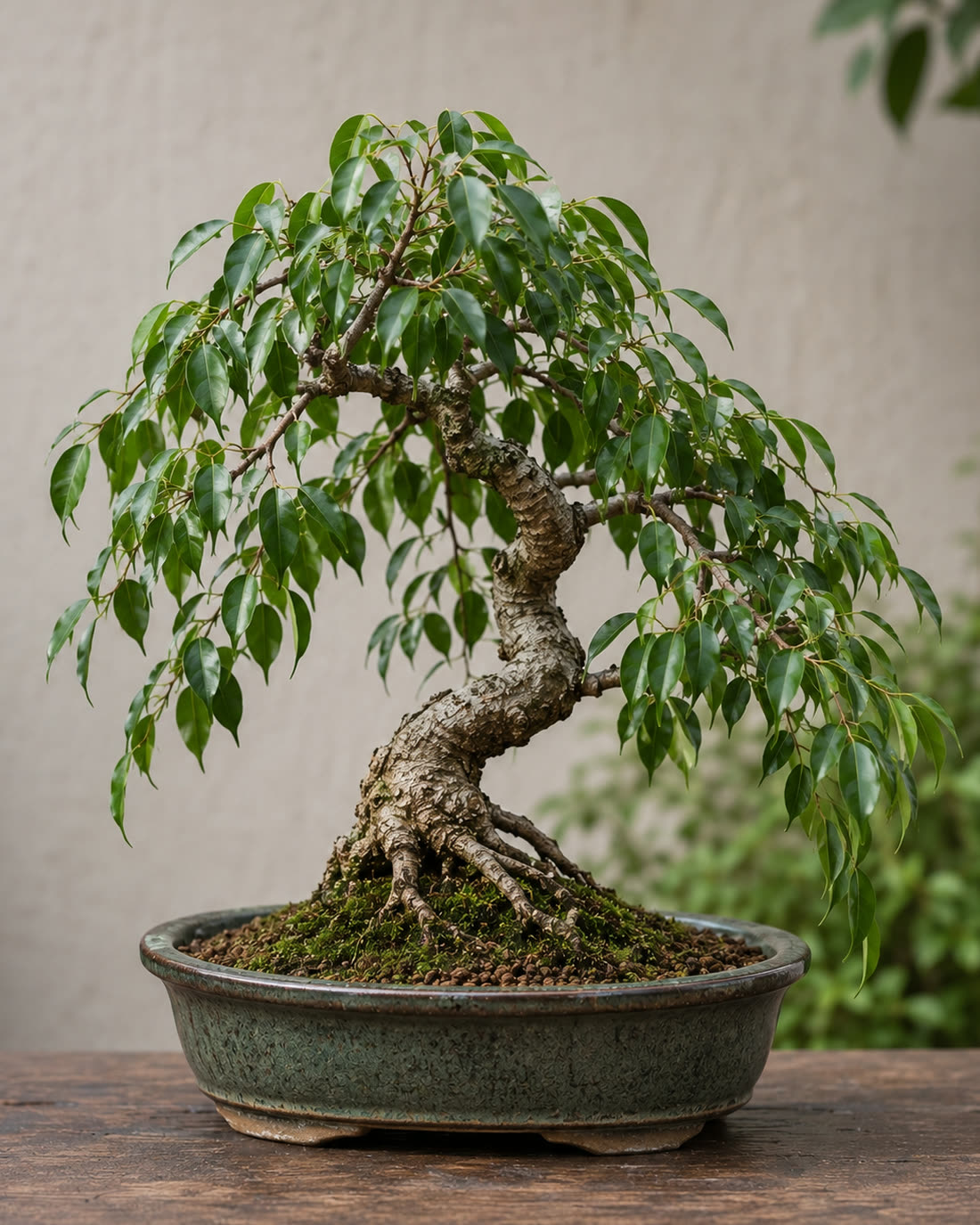
Weeping Fig grown as a bonsai
Family MoraceaeFrom Native to India, South-East Asia and northern AustraliaReady in 1 to 2 years to look convincing, 5 or more to look oldStyles Informal upright, Banyan, Root-over-rock, Twin trunk

A tree that already grows on Gurgaon's own roads, which means the climate is a solved problem before you start.

Of the five, this is the only one genuinely native to this part of the world, and you can see it doing well half a kilometre from your flat. That changes everything, because there is no guessing about whether it will survive a Delhi May. It thickens fast, buds back on bare wood, fuses roots into buttresses, and takes brutal pruning without complaint. Its one famous flaw is theatrical: move it, and it drops half its leaves in protest. Then it grows them back.

DifficultyEasy
Forgives neglectTolerant
How fast it gets thereFast
The show it puts onStriking
What is good about it
  • Proven in this exact climate, because it is already a street tree in NCR
  • Fast. Trunk thickening and visible progress within a single season
  • Buds back reliably on old, bare wood, so mistakes are recoverable
  • Aerial roots and fused trunks give you real banyan drama
  • Leaves reduce well with defoliation, roughly halving in one season
  • Takes hard chops, wiring and root work with equal indifference
What it will cost you
  • Drops leaves dramatically whenever light, position or temperature changes, which is alarming the first time
  • Bleeds sticky white latex from every cut, and it stains hands, clothes and floors
  • Vigorous to the point of nagging, needing a prune every few weeks in the growing season
  • Roots are strong enough to crack a thin pot and escape through drainage holes
  • Wants more light than a typical flat interior provides, so it is not really an indoor tree here

In Gurgaon

The strongest all-round match on this list. The climate is already proven.

Summer, April to June
Thrives. Full morning sun with shade after about 1 pm. In May and June it may need water twice a day, because a shallow bonsai pot in 44°C dries out frighteningly fast.
Monsoon, July to September
Peak growing season, and the right time to defoliate for smaller leaves and to mist for aerial roots. Watch that the pot drains, because a week of standing water will rot the roots.
Winter, December to February
Move it in below about 10°C. It will sulk and drop leaves at the change, which is normal, and it recovers. Keep it in the brightest window you have and water much less.
Water here
Untroubled by hard borewell water. Flush the pot thoroughly every few weeks to wash salts out.
Dust and air
Hose the foliage down after dusty spells. It shrugs off NCR pollution better than most.
Where it lives
Outdoors on a balcony from March to November, indoors by a bright window for the cold weeks.
The actual care routine, and what it looks like
Leaf
Glossy pointed oval, 6 to 12 cm in the wild, reducible to 2 or 3 cm in a pot
Fruit
Small figs, red turning black, on mature trees. Rare in a pot
In the wild
A full-sized avenue tree across Delhi NCR, with a dense weeping crown and a trunk that fuses and buttresses over decades. It often starts as a strangler, germinating in the crook of another tree and sending roots down to the soil.
As a bonsai
The classic tropical bonsai: a heavy flaring base, pale smooth bark, and a dense dark canopy cut into clean pads. Give it humidity and it drops aerial roots that thicken into extra trunks.
Light
As much light as you can give it, with shade from peak summer sun.
Water
Keep evenly moist through the growing season, never sodden. Much drier in winter.
Soil
Open and gritty. Crushed brick or baked clay granules, coarse sand, and a little organic matter.
Feeding
Fortnightly from March to October. It is hungry and it shows.
Pruning
Cut back to two leaves after six or seven develop. Save major chops for just before the monsoon.
Repotting
Every two years in February or March. Root-prune hard, because it does not mind.
Pests
Scale, mealybug, and spider mite in dry indoor winter air. Sooty mould follows scale, so treat the scale rather than the mould.
Where to buy one
Ubiquitous and cheap. Nursery-grown stock works, and so does an air-layer taken off an existing tree.
Mildly irritantThe white latex irritates skin and eyes and is a known allergen for some people. It is unpleasant for cats and dogs but rarely serious.
Pick as many as you like.

Fukien Tea

Carmona microphylla

Also sold as Carmona retusa. The currently accepted name is Ehretia microphylla.

The beautiful difficult one
Hard in Gurgaon

How it could look. An impression at 15 to 45 cm, not a photograph.
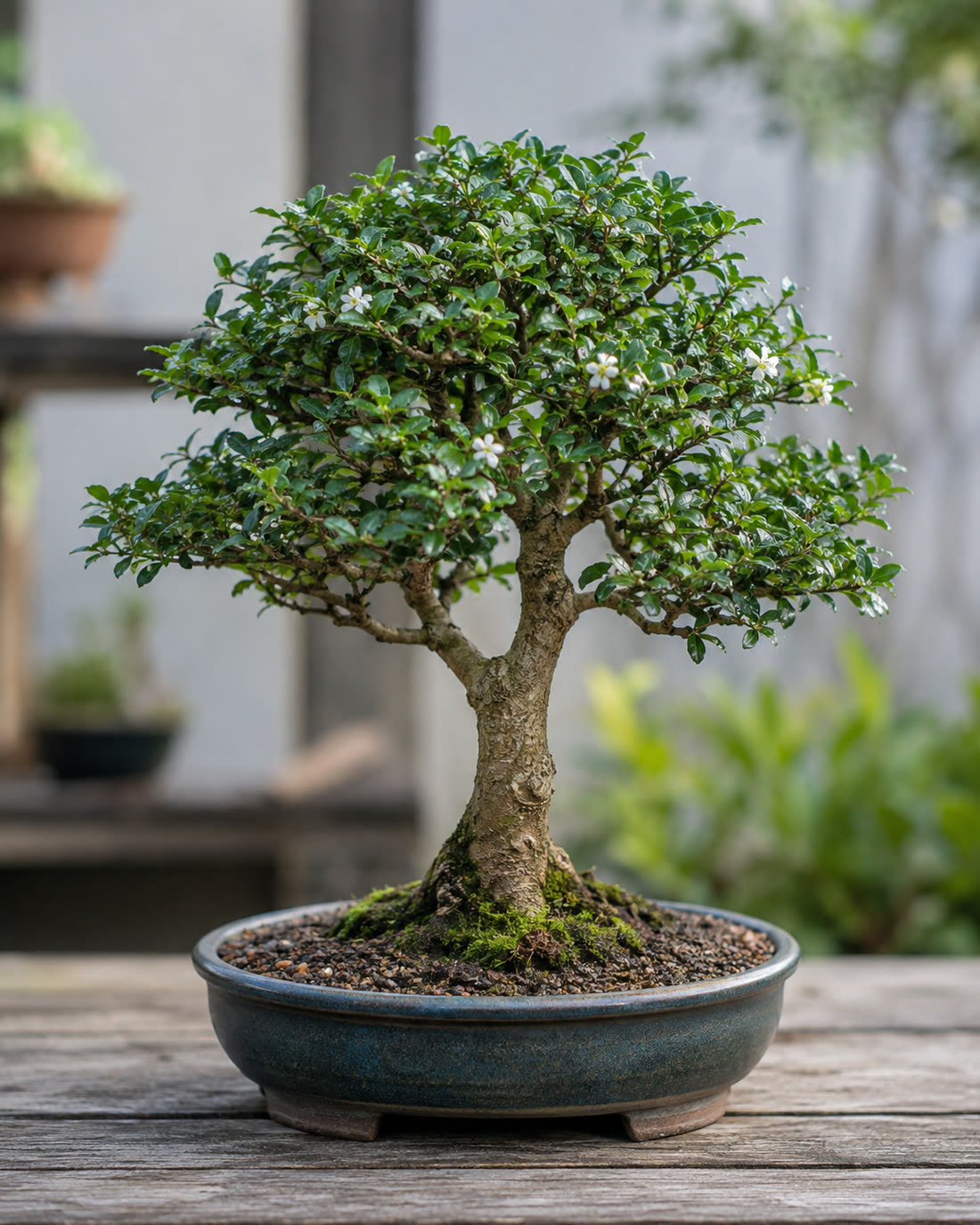
Fukien Tea grown as a bonsai
Family BoraginaceaeFrom Southern China, South-East Asia and the Indian subcontinentReady in 2 to 4 years, and it looks old sooner than the restStyles Informal upright, Broom, Multi-trunk, Cascade

The most finished-looking tree here, and the one most likely to break your heart.

Fukien Tea is the tree in every mall kiosk labelled bonsai, easy care, and it is the single most commonly killed bonsai in the world. That reputation is unfair to the plant and fair to the label. Its leaves are tiny, dark and glossy, it flowers white almost year-round and sets small red berries, and a well-grown one looks like a two-hundred-year-old tree at forty centimetres. It simply demands consistency: steady moisture, humid air, soft water, and no sudden changes. Gurgaon offers hard water and desert-dry winter air, so this one asks the most of you.

DifficultyPunishing
Forgives neglectUnforgiving
How fast it gets thereSlow
The show it puts onShowstopper
What is good about it
  • Naturally tiny leaves, so no defoliation tricks are needed to get the scale right
  • Flowers and fruits at the same time, repeatedly, even on a small tree
  • Bark roughens and looks genuinely aged within a few years
  • Ramifies into fine twigginess better than anything else here
  • Stays small and slow, so it will not outgrow a windowsill
What it will cost you
  • Hates hard, alkaline water, and that is exactly what Gurgaon's supply is
  • Resents root disturbance, and a careless repot can kill it outright
  • Magnet for spider mite, scale, whitefly and mealybug, all at once
  • Gives almost no warning before it declines. By the time leaves drop, the roots have usually already failed
  • Needs humidity that a dry Delhi winter room simply does not have
  • Slow to recover from any mistake

In Gurgaon

The prettiest tree here, and the worst match for this city's water and winter air.

Summer, April to June
Bright shade, never direct afternoon sun, sitting on a humidity tray of wet gravel and out of the loo wind.
Monsoon, July to September
Its happiest weeks, because the humidity is finally what it wants. Make sure the pot still drains freely.
Winter, December to February
The dangerous season. Indoor heating and 20% humidity will bring on spider mite and leaf drop. Group it with other plants, use a humidity tray, and keep it off the cold windowsill glass.
Water here
This is the crux. Do not use straight borewell or municipal hard water, because the salts build up and it declines slowly. Use RO water, collected rainwater, or air-conditioner condensate, which is free, soft and abundant here from April to September.
Dust and air
Sensitive to dust and to pollution-stressed conditions. Rinse the foliage gently with soft water.
Where it lives
Bright shaded balcony from March to November, then a humid, bright indoor spot in winter.
The actual care routine, and what it looks like
Leaf
Tiny, 1 to 2 cm, dark, glossy, with a few blunt teeth at the tip
Flower
Small white five-petalled stars, on and off through most of the year
Fruit
Small berries turning red then black, technically edible, not worth eating
In the wild
In the wild it is an unremarkable dense shrub with rough pale bark and tiny leaves, a scrubby thing you would walk past. Everything that makes it famous only appears under a grower's hands.
As a bonsai
Fine twiggy ramification, near-black glossy foliage, rough craggy bark, and white flowers and red berries at the same time. Of the five, this is the one that looks most like the bonsai in your head.
Light
Bright but filtered. No harsh direct sun, and no gloom.
Water
Constantly, evenly moist. Never soggy, never bone dry, and soft water only.
Soil
Slightly acidic and free-draining, with more organic matter than the others get.
Feeding
Weak feed, fortnightly, growing season only. It burns easily.
Pruning
Trim shoots back to two leaves. Prune lightly and often rather than hard and rarely.
Repotting
Every two to three years, and gently. Tease the roots, do not bare-root. Late February is the window.
Pests
Check the leaf undersides weekly. Spider mite is the usual killer and it arrives in dry air.
Where to buy one
Sold everywhere as a ready-made bonsai, often imported, often already stressed, often in bad soil. If she picks this, buy from a proper bonsai grower rather than a mall stall.
Harmless enoughThe berries are edible and eaten in parts of South-East Asia. Nothing here is a real hazard.
Pick as many as you like.

Water Jasmine

Wrightia religiosa

The one that smells of evening
Good for Gurgaon

How it could look. An impression at 20 to 60 cm, not a photograph.
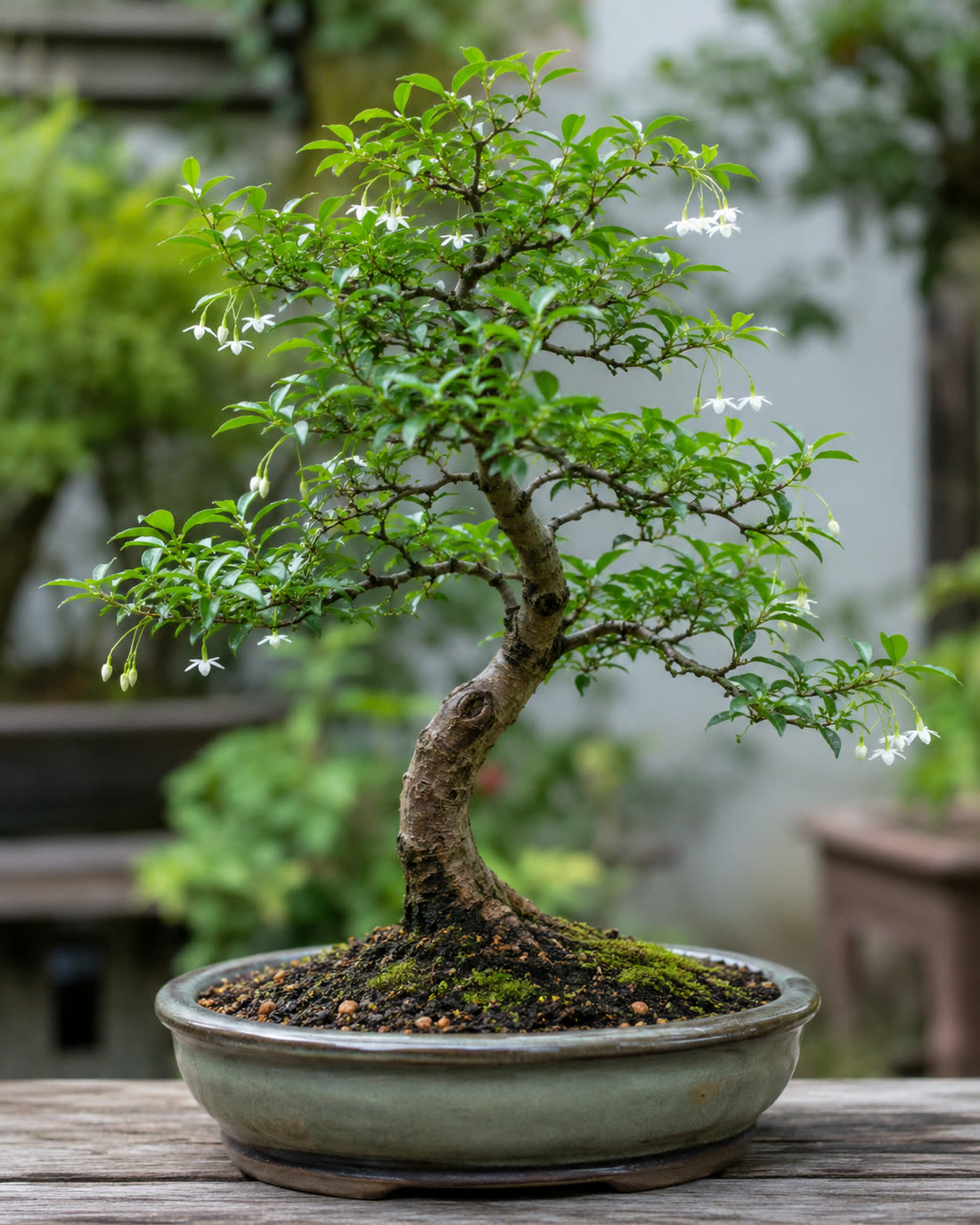
Water Jasmine grown as a bonsai
Family ApocynaceaeFrom Thailand, Cambodia, Vietnam and southern ChinaReady in 1 to 2 years, and it flowers while still youngStyles Informal upright, Multi-trunk, Slanting, Literati

Small white bells that hang under the branches and scent the whole balcony after dark.

This is the tree South-East Asian growers reach for when they want flowers, and it is a genuinely underrated pick for Delhi's climate, because it loves the heat that punishes everything else. It grows fast, thickens fast, buds back anywhere you cut, and flowers in repeated flushes rather than one brief show. The name is a warning as much as a description: it drinks. In a shallow pot in June you may be watering twice a day.

DifficultyModerate
Forgives neglectReasonable
How fast it gets thereFast
The show it puts onShowstopper
What is good about it
  • Actually loves Delhi heat, so the summer that stresses the others is its best season
  • Fragrant white flowers in repeated flushes, not one short burst
  • Fast growth and quick trunk thickening, with visible progress in months
  • Buds back readily from old wood, so hard pruning is safe
  • Small leaves already in proportion for a small tree
  • Flowers young, so the reward does not wait for years
What it will cost you
  • Thirsty. Twice-daily watering in a shallow pot through May and June
  • Brittle branches snap under wire, so it is mostly a clip-and-grow tree
  • Frost-tender, and below about 10°C it needs to come indoors
  • Bleeds white latex when cut, like the fig
  • Constant flower and seed-pod cleanup if you want it tidy
  • Less common in Indian nurseries than the fig or the schefflera

In Gurgaon

Quietly the best-suited flowering tree here, if you can commit to the watering.

Summer, April to June
Full morning sun, light shade in the worst of the afternoon. Water heavily and often, and a humidity tray helps. This is when it flowers hardest.
Monsoon, July to September
Excellent. Warm, wet, and exactly its native pattern. Growth is explosive, so prune often.
Winter, December to February
Bring it in below about 10°C. Growth stops and it may drop leaves, so water sparingly and wait. It comes back in March.
Water here
Tolerant of hard water, though a periodic flush is still worth doing. Volume matters more than quality for this one.
Dust and air
Rinse the foliage after dusty weeks. It is not especially pollution-sensitive.
Where it lives
Sunniest balcony spot from March to November, then a bright indoor corner in winter.
The actual care routine, and what it looks like
Leaf
Small, thin, bright green, 2 to 4 cm, in neat opposite pairs
Flower
Pendulous white bells on fine stalks, in flushes through the warm months
Fruit
Slim paired seed pods, mostly removed by growers
Scent
Sweet and jasmine-like, strongest in the evening
In the wild
A modest flowering shrub planted at temples across Thailand and Cambodia, where the species name religiosa comes from. Its whole reputation rests on the scent rather than the silhouette.
As a bonsai
Pale grey trunk, small bright leaves, and dozens of white bells dangling on thin stalks below the branches. It flowers on a tree that is still visibly a work in progress, which is unusually rewarding.
Light
Lots of it. Direct morning sun, shade from the harshest afternoon.
Water
Generous and frequent. It will wilt visibly if it dries out, and it does not always forgive that.
Soil
Free-draining but water-retentive, with a little more organic matter than the fig gets.
Feeding
Fortnightly through the warm months. A lower-nitrogen feed encourages flowering.
Pruning
Clip-and-grow. Cut back after each flowering flush to force the next one.
Repotting
Every one to two years in February or March. It fills a pot fast.
Pests
Aphids on the new shoots and occasional mealybug. Generally a healthy plant.
Where to buy one
Available from specialist bonsai nurseries and online Indian sellers, and less likely at a general nursery. Cuttings root easily.
Mildly irritantApocynaceae, so the milky latex is mildly toxic if eaten and irritates skin. Worth knowing if she has a cat that chews things.
Pick as many as you like.

Brush Cherry

Syzygium paniculatum

Sold in India as Eugenia, its old genus name. Related to jamun, Syzygium cumini.

The one with the copper tips
Workable in Gurgaon

How it could look. An impression at 25 to 60 cm, not a photograph.
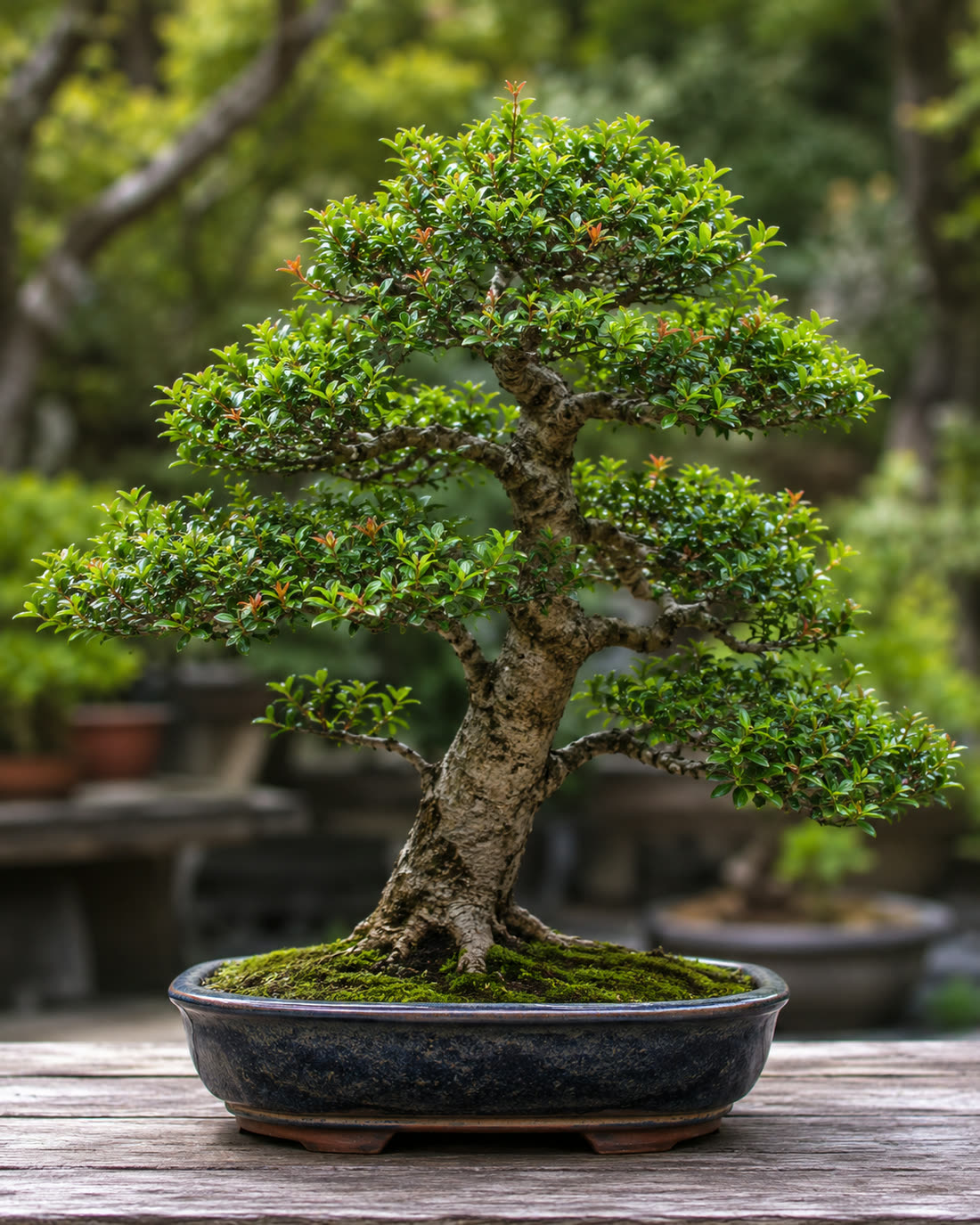
Brush Cherry grown as a bonsai
Family MyrtaceaeFrom Coastal New South Wales, AustraliaReady in 2 to 4 yearsStyles Formal upright, Informal upright, Broom, Group planting

Dense dark foliage that flushes bronze-pink at every new shoot, then flowers white and fruits magenta.

The brush cherry gives you three separate shows: coppery pink new growth, powder-puff white flowers, and glossy magenta berries that are actually good to eat. It shears into dense pads like a hedge plant, which makes clean silhouettes easy for a beginner. It is fussier about water than the fig, wanting steady moisture and sulking at drought, but it is a long way from the Fukien Tea's brittleness. It is slower to thicken than the fig or the water jasmine, so you are trading speed for beauty.

DifficultyModerate
Forgives neglectReasonable
How fast it gets thereSteady
The show it puts onStriking
What is good about it
  • Three seasons of interest: copper new growth, white flowers, magenta fruit
  • The only tree here whose fruit is genuinely worth eating
  • Shears into dense clean pads, so a good silhouette comes easily
  • Small glossy leaves already close to the right scale
  • Attractive flaky reddish bark that ages well
  • Tougher than the Fukien Tea by a wide margin
What it will cost you
  • Wants consistently moist soil, and does not forgive a dry weekend the way the schefflera does
  • Slower to thicken a trunk than the fig or the water jasmine
  • Psyllids can pimple and distort the leaves where they are present
  • Sun-scorches in full May and June exposure without afternoon shade
  • Needs good light, so it is not a viable full-time indoor tree here
  • Less commonly stocked in NCR than the fig or the schefflera

In Gurgaon

Beautiful and quite doable, as long as it never dries out completely.

Summer, April to June
Morning sun, definite afternoon shade. Mulch the soil surface and consider a humidity tray. May and June are its hardest stretch here.
Monsoon, July to September
Very happy. Steady moisture and warmth is exactly its native pattern, so expect a strong flush of copper growth.
Winter, December to February
Handles a cool spell better than the tropicals, but it is still frost-tender, so protect below about 5°C. A sheltered balcony corner is usually enough.
Water here
Even moisture matters more than water quality, though a periodic flush keeps salts down.
Dust and air
Rinse the leaves after dusty weeks so the gloss stays.
Where it lives
Balcony with morning sun and afternoon shade, year-round, with shelter on the coldest nights.
The actual care routine, and what it looks like
Leaf
Glossy, pointed, 3 to 5 cm, in opposite pairs. New growth is bronze-pink
Flower
Fluffy white powder-puffs of stamens, mainly in the warm months
Fruit
Deep magenta berries, crisp, edible, faintly clove-like
Scent
Aromatic foliage when crushed. The family also gives us clove
In the wild
A rainforest-margin tree from a narrow strip of the Australian east coast, where it is actually listed as vulnerable. It is grown worldwide as a clipped hedge and screening tree.
As a bonsai
Tight dark-green pads with copper flushing at the tips, flaky cinnamon bark, and on an established tree white puffs of flower followed by deep magenta fruit.
Light
Bright, with protection from the fiercest afternoon sun.
Water
Consistently moist. Never let the rootball dry through.
Soil
Free-draining but moisture-holding, and slightly acidic.
Feeding
Fortnightly through the growing season, easing off while it flowers.
Pruning
Shear the pads to shape and pinch new shoots back to a pair of leaves. It responds well to regular light work.
Repotting
Every two years in February or March.
Pests
Psyllids, scale and occasional mite. Remove distorted leaves and treat early.
Where to buy one
Specialist nurseries and online sellers, sometimes labelled Eugenia. Worth buying a plant with a decent trunk already.
Safe, and edibleThe fruit is edible and pleasant, crisp and faintly spiced. It is the only one on this list you can actually eat off.
Pick as many as you like.

All five, side by side

The same questions asked of every tree, so the differences are easy to see. Scroll the table sideways on a phone.

TreeIn GurgaonDifficultyForgives neglectSpeedFlowersFruitScentAs a bonsai
Dwarf Umbrella TreeSchefflera arboricolaExcellentNoNoNo25 to 60 cm
Weeping FigFicus benjaminaExcellentNoYesNo30 to 70 cm
Fukien TeaCarmona microphyllaHardYesYesNo15 to 45 cm
Water JasmineWrightia religiosaGoodYesYesYes20 to 60 cm
Brush CherrySyzygium paniculatumWorkableYesYesYes25 to 60 cm

If you asked me to rank them

You do not have to agree with any of this. It is only here so you know what you would be signing me up for.

  1. 1
    Weeping Fig Ficus benjamina

    The safe one. Fast, already proven on Gurgaon's own streets, and it forgives almost every mistake a beginner makes.

  2. 2
    Water Jasmine Wrightia religiosa

    The rewarding one. The summer that punishes everything else is its favourite season, and it flowers while still young.

  3. 3
    Dwarf Umbrella Tree Schefflera arboricola

    The survivor. It will not become a museum piece, but it will still be alive after a fortnight of being forgotten.

  4. 4
    Brush Cherry Syzygium paniculatum

    The pretty one. Copper new growth and fruit you can eat, in exchange for never letting it dry out.

  5. 5
    Fukien Tea Carmona microphylla

    The one worth wanting and worst suited to this city. Hard water and dry winter air are exactly its two weaknesses.

If you want more than one

The best pair is the weeping fig and the water jasmine: one that is almost impossible to kill, one that flowers and smells of evening, and both of them genuinely enjoy a Delhi summer. Add the schefflera if you want something that can live indoors through the winter without complaining.

If it ends up being all five, buy the Fukien Tea last. It is the one that will test whether the watering routine is real, and it is much easier to keep alive once the other four have taught me the habit.


A Gurgaon year, from a small tree’s point of view

This is the part most bonsai guides get wrong for this city. Nothing here survives a Delhi cold wave outdoors, and nothing here survives June without shade. Tap a month.

Pick a month to see what it does to a tree on a balcony.

IndoorsShelteredOpen balconyAfternoon shadeMonsoon, grow hard

True of all five

Whichever one you choose, these are the things that decide whether it lives.

All five are frost-tender

Not one of these will take a Delhi cold wave outdoors. From roughly late November to late February they need a bright indoor spot or a sheltered, covered corner. That is the single most important thing on this page.

Gurgaon water is hard

Borewell and municipal supply here is alkaline and salty, and shallow bonsai pots concentrate that fast. Flush each pot thoroughly once a month. For the Fukien Tea in particular, collect air-conditioner condensate through summer, because it is essentially distilled water and there are litres of it a day.

Skip akadama

The imported Japanese soils are expensive and hard to get here. A mix that works in NCR: one part crushed red brick or baked clay granules, one part coarse river sand or perlite, one part sieved leaf mould or a little cocopeat. Free-draining is the whole point, because a bonsai dies from wet feet far more often than from thirst.

February and March are for repotting

Do root work just before the spring flush, when the tree has a full growing season ahead to recover. Not in the heat of June, and never in the cold.

Two of these are pot-ready, three are projects

The Fukien Tea and the brush cherry are often sold looking finished. The fig, the schefflera and the water jasmine are usually bought as raw material and shaped over a couple of years. That is a real difference in what the first year actually feels like.

So, which one?

Whatever you choose gets bought first. Everything here saves in your browser, so you can wander off and come back to it.

Loading your picks.